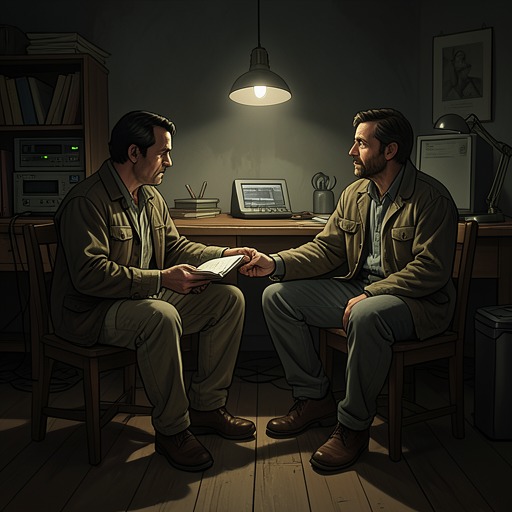
Dennis Tremlett
The LighthouseDennis Tremlett is Nathan Oliver’s copy-editor and secretary of twelve years, as well as the secret lover and eventual fiancé of Oliver’s daughter, Miranda Oliver. His life is bound to Oliver by work, dependence, and a close understanding of the novelist’s creative habits; his relationship with Miranda offers a possible escape from that arrangement but also exposes how uncertain he is about the future. After Oliver’s death, Dennis must face the loss of his employer and the consequences of a romance that Oliver had discovered and opposed.
Identity and Background
Before working for Oliver, Dennis had taught at an inner-city comprehensive, a job he remembered for its noise, violence, and humiliation. He later worked as a freelance copy-editor, where the uncertain prospects and poor pay offered little security. Oliver’s employment removed him from those circumstances and gave him a small, largely unacknowledged part in the making of novels. Dennis is physically vulnerable in ways the narrative makes concrete: he has a slight limp, and the steep descent to the lovers’ hidden meeting place is manageable even for him only by clambering and holding on to the boughs among the rocks.
Dennis’s position in Oliver’s household is an uneasy combination of usefulness and subordination. He considers himself underpaid and exploited, and Oliver never admits him to his full confidence except when they are working on a novel. Yet Dennis knows that his contribution exceeds the formal role of copy-editor. Oliver refuses editorial intervention from his publishers and depends on Dennis to help carry his books through revision. That work gives Dennis both a craft and a sense of participation in a creative process he values, even when Oliver does not openly recognize how much he contributes.
Work and Dependence on Oliver
Dennis’s editing is exacting and physical in its satisfaction: he takes pleasure in the neat marks of addition and deletion and in watching incoherent ideas become a finished novel. Oliver insists on receiving galley proofs before revising, rather than making the changes on a manuscript. He writes alterations in pencil; Dennis transfers them in ink to his own set. Oliver may continue changing a book even between printings, unable to accept that a novel is entirely perfect. The routine makes Dennis an indispensable collaborator, but it also binds him more closely to an employer who controls both the work and the conditions under which Dennis can leave it.
The missing proofs after Oliver’s death therefore matter to Dennis as more than a lost manuscript. Oliver’s marked set and Dennis’s own working copy have both disappeared from the top drawer of the desk, where they had been left unlocked. Dennis tells the investigators that the lost galleys contained important revisions and explains that Oliver would not have burned them: he always wanted to edit at proof stage, and the destruction would erase work that he and Dennis had done together. The loss lays bare the intimacy of their professional method while making Dennis’s knowledge of Oliver’s habits relevant to the murder investigation.
Dennis also understands a side of Oliver that is less visible to readers. During publicity tours, Miranda inspected hotel rooms, managed Oliver’s baths when he could not work the controls, protected his free time, and ensured that he got the food he preferred. She also organized the signing sessions around his exacting rules for dedications. Dennis recognizes that such tours served Oliver’s appetite for public affirmation as well as his stated wish to meet readers. His close observation of Oliver’s needs gives him an unusually informed view of the novelist, but it does not mean that Oliver treats him as an equal.
Miranda Oliver and Their Secret Relationship
For much of the twelve years Dennis has known Miranda, he has regarded her with little affection. Her efficiency and reserve intimidate him; at times she seems not to notice him, or to treat him more like a servant than her father’s confidential assistant. He understands that she has spent years managing Oliver’s demanding habits, but that knowledge initially brings him little more than occasional pity. Their relationship changes when they become lovers. Miranda, who had been a virgin, embraces the relationship with the determination of someone who feels long deprived of love and a life of her own. Dennis, too, experiences an intensity that unsettles him, bringing pleasure and tenderness alongside a new confidence and a release from the fear that solitary sex might be all he could expect or deserved.
They find a secluded place on the lower cliff, roughly a hundred yards south of an ancient stone chapel and less than three yards from a forty-foot drop to a small inlet. High granite rocks enclose the grassy hollow; reaching it requires a steep, boulder-strewn descent, and its concealment makes it unlikely to be found by anyone not seeking a hiding place. Miranda treats the danger and secrecy as part of the refuge’s protection. After making love, the pair lie close physically but absorbed in different thoughts, while Dennis hears the sea and gulls and notices the crushed turf and the plants among the rocks. The clandestine setting reflects the mixture of shelter and risk that defines their affair.
Their intimacy includes long conversations, not only sex. Miranda releases years of resentment and unhappiness, while Dennis becomes increasingly aware of what she wants: marriage, a home, and children. He tells himself that he wants the same future, but her confidence exceeds his. His fear is not simply that Oliver will disapprove. Dennis knows that Oliver’s employment has given him security and meaningful work, and he imagines Oliver will never let him go. The idea of continuing the affair as a secret life seems tempting but, to Dennis, would betray Miranda’s trust. He experiences love as a surrender of privacy too: she seems able to discern his thoughts, as though he has given her access to his mind.
That concealed life is exposed when Oliver sees the lovers from the edge of the upper cliff. Miranda freezes in fear; Dennis breaks free from beneath her and reaches for his jeans before recognizing Oliver. The discovery makes the affair impossible to keep separate from Dennis’s employment and Miranda’s relationship with her father. Later, after Oliver’s death, Miranda tells the investigators that she and Dennis are engaged. In the interview, she reaches toward him possessively, while he hesitates before their fingers briefly touch. Their public declaration is therefore both a fact about their commitment and a moment in which Dennis’s uncertainty remains visible.
The Murder Investigation
Oliver’s death places Dennis among the people the investigators cannot dismiss. Kate Miskin includes him in a narrowed group of suspects because he disliked Oliver, and the team asks why he or the other leading candidates would have waited until that particular weekend to kill him. Dennis’s intimate knowledge of Oliver’s routine and work gives him relevant information, but it also makes his relationship with the dead man a source of suspicion. He is present in the investigation not as a proven killer but as an employee with a grievance, a concealed relationship, and access to the details surrounding Oliver’s last days.
The day after the affair is revealed, Dennis is working from Peregrine Cottage, where the investigators find blackened paper and white ash in the grate. He explains how the missing proof sets were kept and why their destruction would be unlike Oliver. His account supplies a practical measure of the loss: Dennis’s marked-up copy is gone along with Oliver’s, and neither had been locked away because Oliver had not thought that necessary. His testimony also establishes how much of the novelist’s unfinished work passed through Dennis’s hands, making his professional loyalty inseparable from the evidence under examination.
After Adrian Boyde’s death, the police continue to consider multiple possibilities rather than clearing Dennis. Kate Miskin and Francis Benton-Smith debate which suspects deserve priority; Dennis remains on the list alongside Miranda, Emily Holcombe, Arthur Roughtwood, Dan Padgett, and Mark Yelland. The evidence described here does not establish that Dennis committed either murder. Instead, his place in the inquiry underscores how Oliver’s death has turned private resentment, employment, and concealed attachments into possible lines of investigation.
Departure and Uncertain Future
During the island’s emergency arrangements, Miranda insists that she stay in her cottage because Dennis has moved in with her; she also emphasizes that they are engaged and should not be separated. The announcement is strikingly confident at a time of murder and fear, and the investigators suspect she has prepared it in advance. Dennis’s move into her cottage marks a practical change in their relationship, though it does not resolve the doubts he has carried about marriage, children, or his ability to share her plans.
When they prepare to leave Combe Island, Dennis needs only ten minutes to remove his few clothes from their hangers and fold them carefully into a canvas holdall. Miranda packs Oliver’s books into the small cardboard boxes in which they arrived and has arranged a car and driver to meet them at Pentworthy. Dennis helps take the last books from the shelves. Miranda says they will not return; he answers that the memories would make it painful, but adds that they were not all bad. She imagines future holidays in hotels she had visited with Oliver, now as the rich, bereaved daughter rather than the resented hanger-on.
As they pack, Dennis admits that he wishes they had not lied to the police. Miranda rejects his description of what happened, insisting that she told them what her father would have wanted and that he would eventually have accepted her happiness. Dennis’s misgivings remain unanswered. He wonders whether Miranda felt, even briefly, glad when she learned that Oliver was dead, but the question is never spoken aloud in the scene and no response is given. Their departure thus offers movement without certainty: the engagement survives, but Dennis leaves with doubts about their honesty, Miranda’s feelings, and whether the future he has told himself he wants can be made real.